Batman Beyond (2015)

1516060773159-7d3dc54d-beb2-455a-8239-48eaf0769373_The Batman Beyond property has always possessed great potential, even if it borrows heavily in look and feel from Matt Wagner’s Grendel.  Essentially, it has removed the character of Batman from the realm of Bruce Wayne and permitted other individuals to don the suit with their own insecurities and weaknesses.  The showrunner on which the comic is based told of how an elderly Bruce Wayne knighted Terry McGinnis as the new Batman, allowing him to use the technologically advanced Batman suit that Wayne had developed but could never use himself.  As the new Batman, McGinnis created a new mythos of his own, although with hints of Batman’s old allies and enemies.  Barbara Gordon, too aged to be Batgirl, became the new Commissioner Gordon.  There were the Jokerz, a gang of thugs who adopted the anarchic premise of the original Joker, striving in a futile way to incorporate the embodiment of chaos of its namesake.  And then there were new villains, just as interesting and complex as Wayne’s own library of villains.

But DC released its crossover event, Future’s End, which, personally, I loved, but, rewrote part of its history, as DC is wont to do, a tradition starting with the mother of all crossover events, Crisis on Multiple Earths.  Like all crossover events, it was the publisher’s raison d’etre for shuffling the continuity cards, erasing some characters and changing others.  Batman Beyond was no different.  At the end of Future’s End, Terry McGinnis had sacrificed himself with Tim Drake, the former Red Robin, being shuttle into the future and made the new Batman Beyond. 

Batman Beyond #1 (2015) begins where Future’s End left off.  Tim Drake is the new Batman.  There are Jokerz.  Even Barbara Gordon, Bruce Wayne, and Terry’s younger brother, Matt McGinnis are present.  However, the world is a different place than when Terry was there.  As Tim notes, “Butterfly wings, ripples in the pond, and all that stuff.”  Dan Jurgens goes to great length to tell us how different, reminding us constantly that we are not in Terry McGinnis’s world anymore.  Such repetition narratively makes the story less compelling than the Batman Beyond of old, where television viewers and comic book readers would have to navigate a world a little uncertain and in the dark about the lay of the land.  Such uncertainty was used so well that it served as a plot device in Batman Beyond: Return of the Joker.

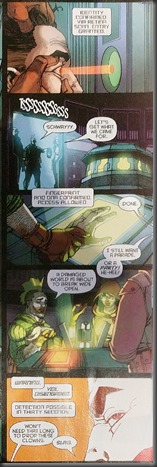
To a certain extent, the art by Bernard Chang too tries to capitalize on the success of other material, in this case, the artwork of Andrea Sorrentino.  There are panels in the first act of the book which reflect the dual tone to reflect dramatic events in the book’s progress.  Yet, these attempts are weak.  The moments lack 1516060951424-8ffe1848-724f-4e2d-88f3-3c1dff8e9596drama.  There are mere reflections of confusing fight sequences that are inconsequential and meaningless.  They are wasted panels, and such waste does a disservice to the book as a whole. 

What the book does, it does well.  It establishes a plot, and cleanly so.  It is divided cleanly into three acts, the first, the casual interruption of the theft of veil technology keeping Gotham safe from Brother Eye.  The second scene develops the secondary plots which obviously will arise later in the book.  The third act places Tim Drake in the mix of the larger problem of the arc of the book, the problem of Brother Eye, with a clear cliffhanger at the end with the appearance of Barbara Gordon.  But, in a way, its too clean, too predictable. 

Admittedly, I did not collect anymore of this book.  Having read the first issue, I am glad I didn’t continue.

Comments

Popular posts from this blog

Fantastic Four (1961-1998) #36, #38 - #43

I am reading a collection published by Marvel regarding the Origins of the Inhumans.  It starts with issues of the Fantastic Four in which they encounter the Frightful Four, a team composed of the Wizard, who sometimes calls himself the Wingless Wizard, the Sandman, Paste-Pot Pete, who also changed in his name to the Trickster, and, the Inhuman, Medusa.  The series of Fantastic Four issues starting with issue # 36 and running in issues # 38 through # 43 are a confusing jumble of ideas and plot written and drawn by the infamous team of Stan Lee and Jack Kirby. The Fantastic Four have been one of the core comics around which Marvel has built their Marvel Universe, its villains and guest superheroes have spun off into a number of series themselves.  Like all comics from the beginning era of Marvel, Lee and Kirby incorporated certain themes into their work which form the basis of how we were to read the comics.  These themes are exposed especially in those issues with th...

Everyone Loves Tank Girl #1

I read Martin and Hewitt’s Tank Girl as a teen in high school.  I was attracted to the rawness of the artwork as well as the bawdiness of the stories.  It was a four issue mini-series as recalled.  Hewitt went on to help develop with that guy from Blur the concept band Gorillaz, which has been successful in its own right.  Unlike most comic book series, the original issues were split into smaller stories, usually with some kind of punchline at the end.  Also infused into the comic was a lot of social satire, poking fun at a society obsessed with celebrity.  Tank Girl has continued on with various different artists filling in with the same general bawdiness and social satire. Everybody Loves Tank Girl carries on in that tradition, a series of bawdy tales ending with a kind of punchline at the end.  While Martin has remained on writing duties, Jim Mahford has taken over artist duty. But comics have changed over the last twenty years.  The art has ch...

Black Bolt #1 (2017)

The Inhumans have always been an interesting set of Marvel Comics characters.  Their creation obviously was a construct of several themes going beyond just muscular-bound men and buxom women “pow-ing” and “zapping” their way through the panels.  Through their adventures, many writers have explored the themes of monarchies, family, social status, genealogy, inheritance, individuality, genetics, and history, just name a few.  I have always had a fondness for the character of Black Bolt, who, by inheritance was king, but, through the Terrigen mist, was essentially mute because the single whispered word  passed through his mouth causes destruction, a symbol of the unforeseen consequences a ruler has when he speaks.  In addition to having to govern over his people, he has to contend with his insane brother, Maximus, who seeks to dethrone Black Bolt and take his place. In recent Marvel history, Black Bolt has suffered under the weight of his throne, such that he was r...