The Avengers #130 (1963)

When the Guardians of the Galaxy were revived in the 2000’s as a modern team led by Starlord and, whose members not only included Rocket Racoon, Drax, and Gamora, but also the Celestial Madonna herself, Mantis, who, although green, still possessed the sprouting antenna and the coal black hair of the original Mantis.  Unfortunately, James Gunn did not make Mantis a part of the Guardians team would he filmed the first of the films starring the team, but she appeared in the second, albeit to some criticism for the her portrayal as ineffectual and the recipient of many of Drax’s jokes.  (As of the date of the publishing of this post, I have not seen the film yet and cannot confirm such criticism though released images of the film suggests that they are not far off base.)
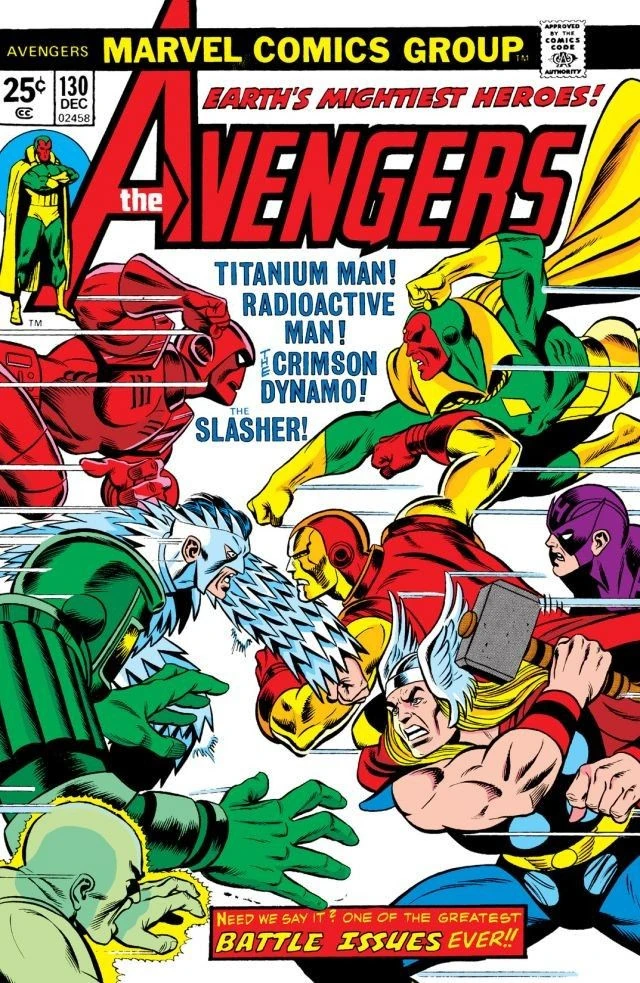
With the release of the film, Comixology and Marvel sold a collection called the Celestial Madonna Saga telling the story of Mantis’s time spent on the Avengers while she attempts to discover the truths to her true identity.  Right smack in the middle of the saga is issue #130 of the Avengers entitled “The Reality Problem!” written by Steve Engelhart with art by Sal Buscema and Joe Stanton.

The issue takes place after the Swordsman, Mantis’s spurned ex-lover imagesacrifices himself by stepping in front of blast from Kang, to save the subject of his unrequited love, Mantis, from death.  Mantis, who thought Swordsman to be ineffective and weak prior to his sacrifice, regrets her behavior, and, as a token of her devotion to her, decides to have him buried in the Temple of the Priests of Pama, Kree pacifists living within the borders of Vietnam.  While there she intends to uncover the truth of her identity.  To aid her in her quest, Iron Man, Thor, Hawkeye, and the Vision accompany her.

It is an odd issue because it really operates on so many different levels which weave between each other.

imageOn one level, Buscema writes a simple heroes thwart villainy story, one in which the villain, the Slasher, robs a Vietnamese diamond exchange and then encounters the Avengers as he is waiting for his fencer.

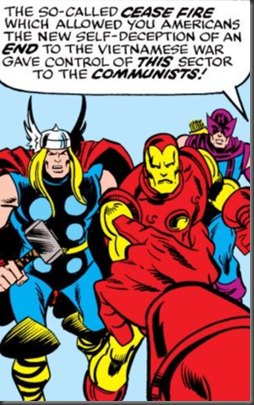
On another level, Busecema imagewrites a story reflecting the difficulty of defining justice when political boundaries are considered.  Specifically, the Avengers who are on foreign, i.e., Communist soil in Vietnam, encounter villains who are known communists, i.e., the Crimson Dynamo, Titanium Man, and Radioactive Man, in the middle of doling out punishment to a man who clearly killed his wife, though his intent was never fully explored.

On yet another level, Buscema writes a story in which the heroine, i.e., Mantis, discovers that all that she knew is false, particularly that which she knows about herself, and struggles with discovering her own identity in which so much of who she is dependent.

The three stories having been deftly set up by Buscema came colliding at the end of the issue when, the Slasher believes that the Avengers have come to thwart his plans and enlists the aid of the the Communist trio of the Crimson Dynamo, Titanium Man, and Radioactive Man to dispatch them.  However, his plan fails when the Vision makes him spill the stolen diamonds on the ground and spill the his true intentions to the Communist villains.

Adeptly, Buscema shows how reality can be skewed based on false beliefs.  Each of imagethe characters in the issue suffer from false beliefs which led to their own troubles.  The Slasher mistakenly believed that the Avengers were in Saigon to thwart his plans.  The Avengers mistakenly believed that the Communist villains were hurting an innocent man who had actually killed his wife.  The Communist villains mistakenly believed that the Avengers were violating the sovereignty of Vietnam by stepping in and preventing it from administering justice in its own ways.  Mantis mistakenly believed that she had grown up in Saigon when in fact she had never been to any of the places she believed she had. 

Even in a weird kind of commentary, Buscema raises the conflict between Iron Man and the Crimson Dynamo over the death of Janice Cord, the love of Iron Man.  Iron Man believes her death to be the Crimson Dynamo’s fault.  The Crimson Dynamo rebuts this premise later on the issue turning the tables on the Iron Man, insinuating that Cord’s death was Iron Man’s own fault.

It is interesting that this comic was written in the 1960’s in which so much of American politics was consumed with trying to clearly demarcate evil governments, namely, those governments of the East, i.e., Communist blocks.  The subtext in the issue recognizes that justice is tempered by perspective.  Buscema presents shifting ground were the reader is constantly caused to shift perspective, so much so that the reader has no real sense of who in fact is the “villain” or the “hero.”  No one is blameless, and yet, each of the characters save for maybe the Slasher is justified in their actions. 

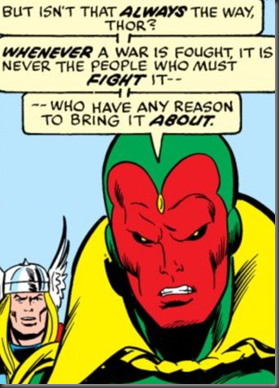
When read in the context that this comic was imagewritten in the middle of the Vietnam War, it becomes clear that Buscema is commenting on the correctness of the war, its plot an allegory for the motivations of the War.  Eerily, in the last panel, the Vision, the voice of logic, his face filling the panel staring out at the audience, sublimely admonishes the reader about the justice of the War.  Talking to Thor, he states: “But isn’t that always the way, Thor?  Whenever a  war is fought, it is never the people who must fight it—Who have any reason to bring it about.”
Comments

Popular posts from this blog

Green Arrow #51 and #52

I have to admit that I like the idea of Green Arrow, a robin hood type figure who fights for the poor and meek against the rich and strong.  I think as much as any other character, Green Arrow seems to have gone through many manifestations.  Perhaps a better word might be reincarnations.  I think Green Arrow, although not one of the trinity of DC Comics lead super heroes, is subject to manipulation by comic book writers and artists, simply because he is a paragon of pity and mercy for the poor, similar in the manner that Batman is the paragon of true justice. When DC Comics rebooted their comic books under the New 52 brand, there was a lot of hope for the books.  One of the books they re-launched was Green Arrow.  It started very roughly.  The writers and artists had taken away from him his wisdom and experience and replaced it with youthful vanity and inexperience.  I started the book (and continued collected I am ashamed to say) even though I felt th...

Batman Beyond (2015)

The Batman Beyond property has always possessed great potential, even if it borrows heavily in look and feel from Matt Wagner’s Grendel.  Essentially, it has removed the character of Batman from the realm of Bruce Wayne and permitted other individuals to don the suit with their own insecurities and weaknesses.  The showrunner on which the comic is based told of how an elderly Bruce Wayne knighted Terry McGinnis as the new Batman, allowing him to use the technologically advanced Batman suit that Wayne had developed but could never use himself.  As the new Batman, McGinnis created a new mythos of his own, although with hints of Batman’s old allies and enemies.  Barbara Gordon, too aged to be Batgirl, became the new Commissioner Gordon.  There were the Jokerz, a gang of thugs who adopted the anarchic premise of the original Joker, striving in a futile way to incorporate the embodiment of chaos of its namesake.  And then there were new villains, just as interes...

Review of Civil War II: Gods of War #1

Apparently, Marvel’s Hercules had a book.  And, apparently, Dan Abnett wrote the book.  I hadn’t known this.  Or perhaps, I did, only I didn’t pay attention, filtering it out of my sphere of comic books that I read or consider, much like a husband might filter out his wife.  The last time I read a Hercules book was years ago, back when Marvel “killed” Hercules off.  (Like you could really kill a God.)  I enjoyed the book then as something I might pick-up as a distraction from the more prominently advertised titles.  It was not memorable, but it was fun. When I discovered that Marvel intended publishing a Hercules book that “tied-in” to Civil War II, my interest was peaked, and I picked it up.  And as I had done in the past, I enjoyed Gods of War, and thought that, compared other titles Marvel and DC has released recently, it was a strong offering by writer Dan Abnett and artist Emilio Laiso. The reviews I read after reading were not so kind...